What about that guy?
1 Like
He wrote Peaky Blinders, a very shit show about Cillian Murphy looking serious in poorly lit rooms and walking down grimy alleyways in slow-mo camera shots.
4 Likes
Idk, many people liked the show.
I took Scats comment as half tongue in cheek. It was an excellent show, but there was a whole lot of Cillian Murphy looking serious in dingy alleys and poorly lit rooms. Lots of slow motion explosions and back then a lot of the streets weren’t paved and plumbing was not like it is now so they are literally walking around in shit sometimes.
3 Likes
It was not tongue-in-cheek at all - I think Peaky Blinders is absolute turboshite, all style (and a style I don’t like at that) and no substance. That said, I looked further into Knight’s resume and I really liked the film Locke, so hopefully his writing for Bond approaches that end of his quality spectrum rather than the Peaky Blinders end. 
2 Likes
Not been around for the last few days due to birthday stuff, but beforehand I beat (almost) every Bond game. I had only played the two N64 games before, so decided to pick up and play anything I was able to play on physical hardware. Here’s my ranking of the games after my marathon:

I also got a couple of bits of memorabilia as gifts, which made my Bond game collection seem a bit more padded out (got a couple of Alien bits too, so didn’t crop that out just in case you were interested):

6 Likes
Nice! I wanna go on a bit of a Bond game marathon myself once I get some unfinished games out of the way. Only ever played Nightfire (and the PC version at that), so I want to catch up, at least on the games I can run.
How do the different versions of The World Is Not Enough compare? I heard the PS1 one is inferior to the N64 version?
4 Likes
Get a couple of buddies to come over for Goldeneye! It’ll be hard to capture all of the fun from yesteryear but the multiplayer was super fun. No online stuff just split sceeen couch play, and yes, you totally looked at other people’s screens 
4 Likes
I like all the versions of TWINE, especially as they’re all completely unique games. The N64 one is best as it has the better control scheme (and multiplayer), but I’d honestly say they’re about as good as watch other. Some stages are better on one, some are better on another.
GBC version is a little more annoying, but I still liked that one too!
3 Likes
Appreciate the clarification! I´ll try to give both a whirl then. Mainly the PS one, since I don´t know how well I´ll fare with N64 emulation. Won´t probably bother with GBC though.
Aye, that´s what split screen was like no matter the game Hopefully I´ll be able to emulate Goldeneye, though I might just wait for the decomp to finish 
2 Likes
The PS one can be hard to start off, as the first level isn’t the most interesting (although I like how you finish the stage) and the single stick moving and turning feels very antiquated. But it’s still worth it!
Hopefully you can get TWINE working, and GoldenEye shouldn’t be too hard since I think that’s playable on PC now?
1 Like
I haven´t dabbled in PS1 emulation yet, but I´m hoping they have the single stick stuff sorted out somehow. Will see.
From what I gathered, it´s playable with MKB via a particular build of the N64 emulator, so that would be my first try, but there seems to be a decomp in the works that should provide an even better experience, so I might just wait for that. I´m planning on playing the PS2 and PC releases first, so it will probably take me a while to get there.
1 Like
The Edinburgh Filmhouse, as part of the Edinburgh International Film Festival, and presumably to help advertise the 4K restorations, are showing the 6 official Connery Bond films this week. I saw Dr. No on Friday and From Russia With Love on Saturday.
The Filmhouse has had a recent restoration. The seats are nice and the theatre itself is lovely. Shame there doesn’t appear to be any AC though. I assume it’s not possible because of how old the building is, but on both days, particularly on Friday, it was pretty stuffy. Wasn’t even that hot compared to other days, Friday was around 21-22C, and the theatre was only about 60% full. Wouldn’t want to be in there on a hotter day with a full crowd to be honest.
It has been a while since I’ve rewatched any Bonds. I’ve never seen these 2 particular Bonds in the cinema before. My opinion on either hasn’t really changed on seeing them again, but it was nice for the ambience, and for the new restoration. Jamaica in Dr. No looks like it could of been shot yesterday, the establishing shots as soon as the title ends are just insane in how good they look.
It was interesting to have an audience in the room. Dr. No didn’t get too much reaction. I heard a few audible shock noises when Quarrel is iced by the photographer lady. Laughter when the music sting is timed with Bond hitting the spider with his shoe. And after Honey Ryder tells the story of killing her rapist with a black widow spider, and Honey asking if she did anything wrong, Bond’s quip of “don’t make a habit out of it” got a few laughs.
From Russia With Love was definetly more lively. Think at least a good dozen moments got laughter in the audience, mostly for bits that were meant to be funny. I think Kerim Bay actually got the most audience approval, a lot of his lines were met with laughs. Also the scene with M, Moneypenny, and the various officers listening to the tape Bond has recorded. Rosa Klebb’s death also got some laughs with how long it took her to die after she was shot.
In terms of stuff I noticed, I couldn’t help but think of Honest Trailers video about the Connery Bonds, and how in them they would spend time establishing stuff like Bond checking into his hotel, and then looking around his hotel room. Was quite interesting in Dr. No for them to even include a very small scene of the hotel receptionist saying Bond’s rental car had arrived, to set up Bond’s car chase with the Three Blind Mice later. Couldn’t help but also find it a little funny that when Bond is picked up at the airport, Bond complains that the driver is going to quickly on an empty country road, and you can clearly see the speedometer says just less than 60mph. Still don’t know what the whole 13th/14th day of the month is about in From Russia, Bond wants to do the plan on the 14th, then does it on the 13th?
As for my opinions, not much has changed. I like Dr. No, but I don’t love it. Probably lower middle in my Bond ranking. Honestly, I think the film’s strongest stuff is on Jamaica, it’s nice to see Bond investigating in (what seems like) a relatively low stakes affair. The jungle stuff on Crab Key is fine. The dinner scene with the titular Dr. No is excellent, and a real hallmark for all other Bond and villian interactions to follow. But after that? The film just kindof ends, like they ran out of time or money. Hard to care much about the US space program honestly. Dr. No’s death by his hands is great, but I really wish him and Bond got another conversation, or proper confrontation.
From Russia With Love, easily in my top 10, possibly even top 5. So well paced, such great atmosphere, setting, etc. Honestly my only real issue with the film is that I think it goes on a little too long after Red Grant dies. I’d chop the helicopter fight scene, even if it is a great action scene. I actually felt bad for Tanya watching it this go around. I’ve always liked her as a Bond girl, and I really wish Bond did something to apologise for how he treated her after Kerim Bay dies. Honestly, kindof begs the question even why she chose to shoot Klebb in the end. But still, great movie.
May get around to rewatching more Bond movies soon. My Bond appetite has started to grow now that the IOI Bond game is on the horizon. I actually don’t own No Time to Die, and have still only seen it once since it came out. It just left me very cold and conflicted, perhaps time I need to give it a rewatch and reevaulate it.
6 Likes
Rodger Moore 4K Bond Collection by Warner Bros Home Media is coming soonish.
Will be similar to the Sean Connery release and will most likely have an Amazon/Zavvi exclusive limited run Steelbook collection.
1 Like
I’m a huge fan of Sephen Follows and his movie blog. In his latest entry he thinks about the new Bond-Actor. I’m pretty sure it will be Tom Glynn-Carney – as backed up by this data. But who knows…
What the data says about who should be the next James Bond
I scored 460 British and Irish actors against six decades of Bond casting decisions to see who actually fits the brief, and where the audience and the studio are pulling in opposite directions.
Apr 27, 2026
Predicting who will be the next James Bond has become one of the great communal conversations. Whether that’s via prediction markets, professional bookmakers, newspaper headlines, or just down the pub - everyone has an opinion.
I think it should be said loud and often that this is a deeply silly thing to bet on. Predicting the Bond casting is less of a science, more like forecasting the weather next Christmas (ie, will it be white).
There are real underlying patterns in the historical data, but the actual decision is being made in private by a small group of people working with information you and I do not have. Even the professional bookies are essentially trading on rumour, public sightings, agent gossip, and the occasional carefully-placed leak.
I hope the silliness of my video above conveys how seriously this should be taken. BUT… that’s not to say the topic lacks merit. A number of important ideas around casting, acting, and IP management emerge as we frolic through the data. So, let’s take a look with a view to gambol rather than gamble.
The current state of play
At CinemaCon 2026 a few weeks ago, Courtenay Valenti, Amazon MGM’s head of theatrical said:
Now, I know you’re all wondering when we’re going to announce who’s playing James Bond. Please know that we’re taking the time to do this with care and deep respect. It is the dream of a lifetime for all of us to bring audiences this next chapter, and it’s a responsibility we don’t take lightly.
What I can tell you is this: when you pair one of the most beloved franchises in history with a world-class filmmaking team… setting the stage for something that’s truly worthy of the Bond legacy. That film is coming, and when the time is right, we’ll have much more to share .
This means we all have a brief window in which to have fun speculating!
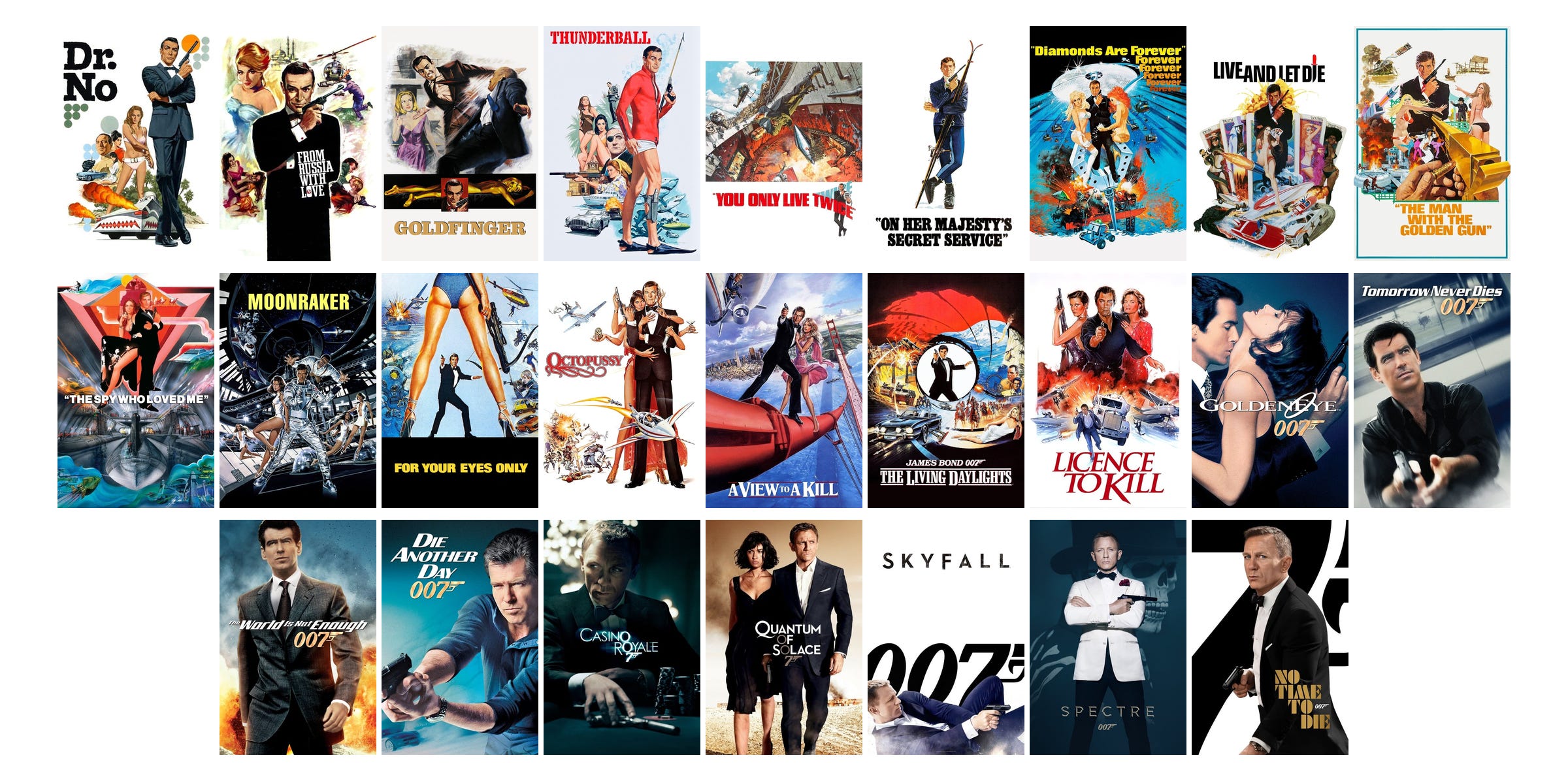
Let’s put ourselves in the shoes of the top Bond brass at Amazon. You have been handed the most consequential casting decision in commercial cinema. You don’t have a name in mind. You have a brief, a budget, a multi-billion-pound franchise, and a producer breathing down your neck. How do you build the shortlist?
The honest answer is that it is a series of cuts. Some hard. Some soft. Some defensible by data, others by gut feel and politics. By the end of the process, you should have a list of perhaps five names sitting on a desk in a building Amazon hasn’t shared with the rest of us.
Let’s see how far we can get with the public info we have…
The hard requirements
The hard requirements are the cuts you can defend with a sentence. Each one is a decision a producer would actually make in week one of the search.
1. Male
Bond producer Barbara Broccoli said only a couple of years ago that:
He can be of any colour, but he is male.
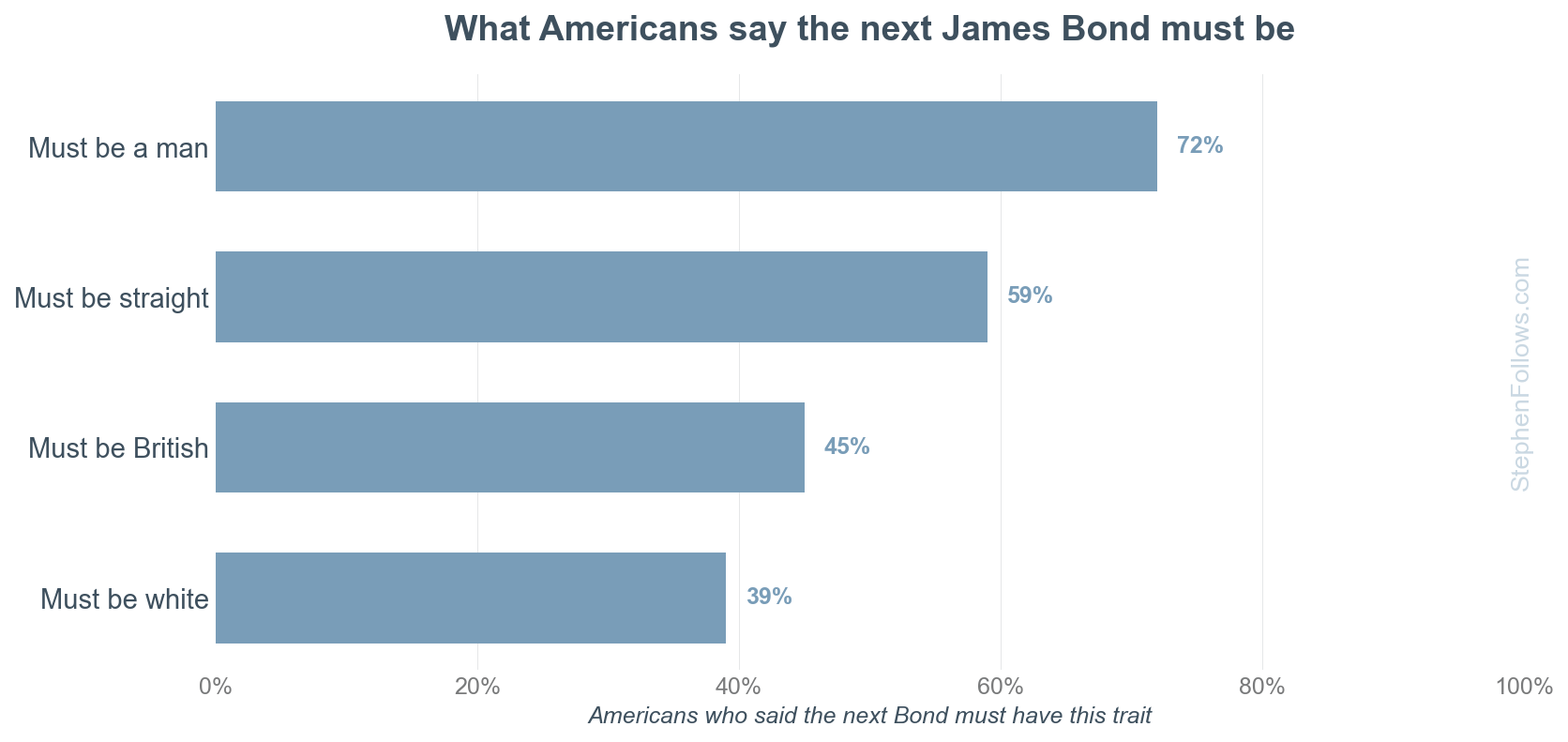
It’s not clear to what extent Amazon agrees, but the vast majority of the public does. A YouGov poll from 2023 asked Americans which traits a future Bond must have.
The public is conservative on gender (72% want a man) but genuinely open on race (only 39% require a white actor).
So when doing my first pass cut of names, I followed the majority on the male requirement, and left race open.
2. British (or convincingly so)
This is the cut where the data and the principle disagree.
The whole concept of acting is one about convincing people you’re something you’re not. Therefore, on the one hand, it seems absurd to place a birthplace requirement on the person who goes running around with a fake gun, fake-killing other liars in a fictional story we all know didn’t happen.
But now we touch on another aspect of casting - believability. The audience needs to be willing to suspend their disbelief and stop seeing the actor and start seeing a real superspy. And nationality plays a part in this shared public delusion.
Deadline reported in September 2025 that the casting brief for Bond 26 is:
British , male, unknown, late 20s to early 30s.
So whatever I think about national-flag accents, it seems like I need to keep it as a hard rule with which to filter our candidates.
(The rule I settled on was more accurately “The British Isles” than just “Great Britain”. The differences between all the ways people describe the islands is a massive rabbit hole. If you have two minutes, watch this; if you have two hours, watch this).
3. In their thirties
Amazon has to be hoping that they pick the right person now and get to ride that successful casting for at least a decade, maybe two. That places extra pressure on the person to be as young as possible, while still pulling off the role in their debut Bond (likely release date is 2028)
Broccoli told Variety in 2022
When we cast Bond, it’s a 10, 12-year commitment. So he’s probably thinking, do I really want that thing? Not everybody wants to do that.
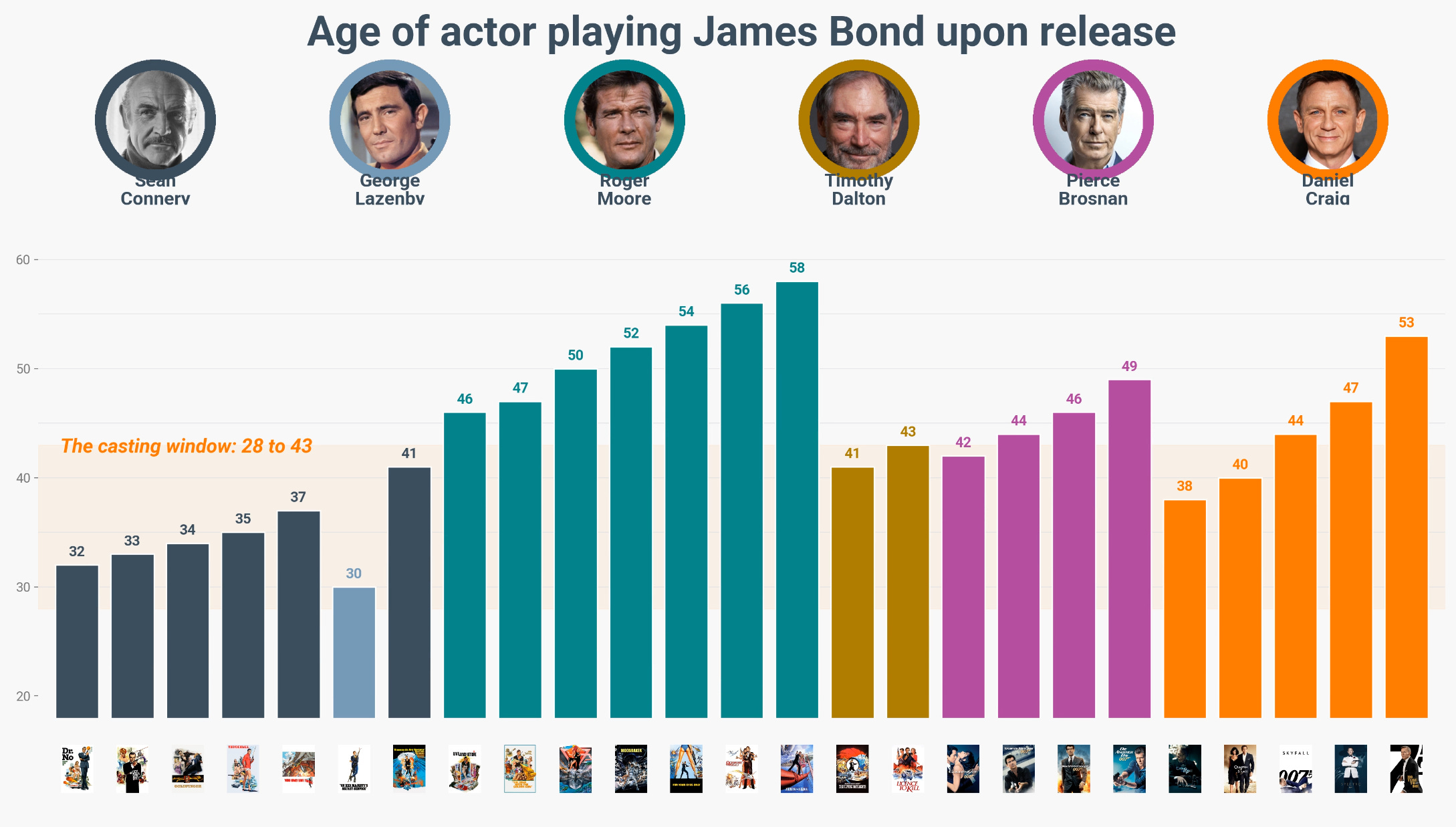
The two most commercially successful Bonds were the youngest at debut. Connery had a nine-year run from 32. Craig ran from 38 to 53 across five films and $3.97 billion in box office. Moore made seven films but was visibly ageing out by the end.
4. A working professional with real films behind them
Playing Bond is a hard gig, both on- and off-screen. Long-press tours, multi-year shoots, action choreography, and the requirement to anchor a film against an A-list villain.
The clearest description of what this means in practice comes from Debbie McWilliams, the casting director who has been with the franchise since Roger Moore and personally cast Dalton, Brosnan and Craig. She told SlashFilm:
He has to look like a regular guy. You can’t be Dwayne Johnson. He has to have a great physique, but he shouldn’t stand out in any situation. You feel a very strong presence in the room with him, and I think that is incredibly important.
In my filtering, I opted to look at people with at least three feature film credits, although obviously, a real casting director can take a more nuanced view on who is able to take on the mantle.
The soft requirements
Once we apply these filters, there are fewer than 500 candidates left. We’re still at the point where we couldn’t call them all in for a casting session, but we could start a spreadsheet.
The hard requirements give us a list of professional actors, and now we can use soft requirements to surface people we might otherwise overlook.
Although data can give us pretty and definitive-looking charts and tables, we are firmly in the ‘Cosplaying as a Casting Director’ territory at this point. It’s a fun thing to make YouTube content with, but let’s not confuse this with hard science.
For example, acting ability is important here. Bond isn’t a dumb 80s action thriller where we can overlook the leads’ acting because of the size of their quads or how often they can do the splits. A real casting director will know in seconds whether the actor is the worst thing in a good film or the best thing in a directionless one. But the data can’t see this kind of thing.
So let’s see what we can measure to reorder the candidates in interesting ways.
1. Has prestige
The actor who takes on Bond will need to have a certain amount of heavyweight prestige about them. They can’t be a silly Adam Sandler / Kevin James type.
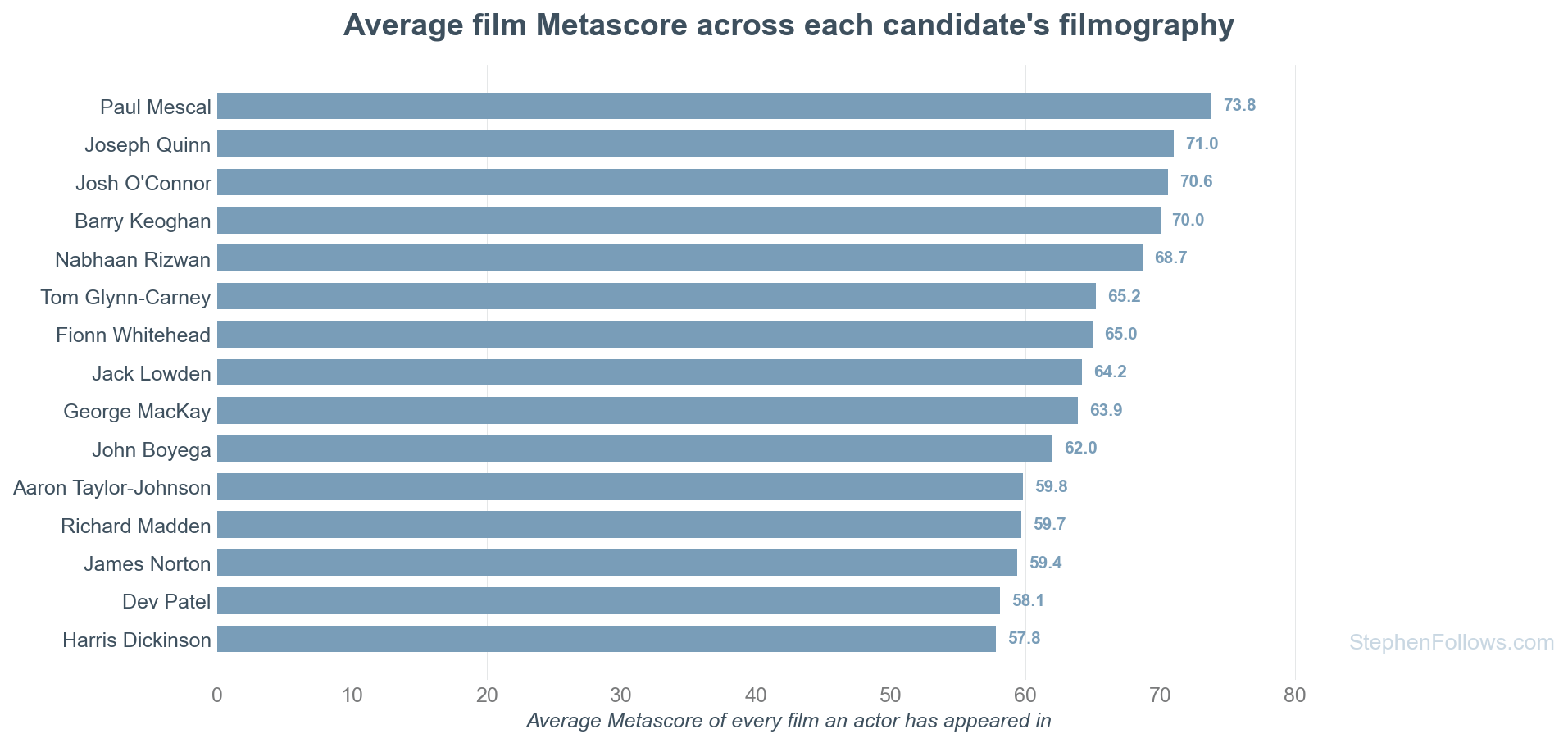
Looking at the Metascore of the movies each of our Bond-wannabes has been in, surfaces Paul Mescal, Joseph Quinn, and Josh O’Connor.
When asked a couple of years ago about the role, Joseph Quinn said:
Yes, in fact I just did a Zoom with Barbara… It would be fucking stupid to say no that… But come on, it doesn’t even make sense to think about it.
2. Doesn’t often feel miscast
Another signal we might look at is how well the actor has convinced the public in their previous roles. I pulled audience reviews and tracked mentions of “miscast”, “wrong for the role”, “unconvincing”, “didn’t fit” with each actor.
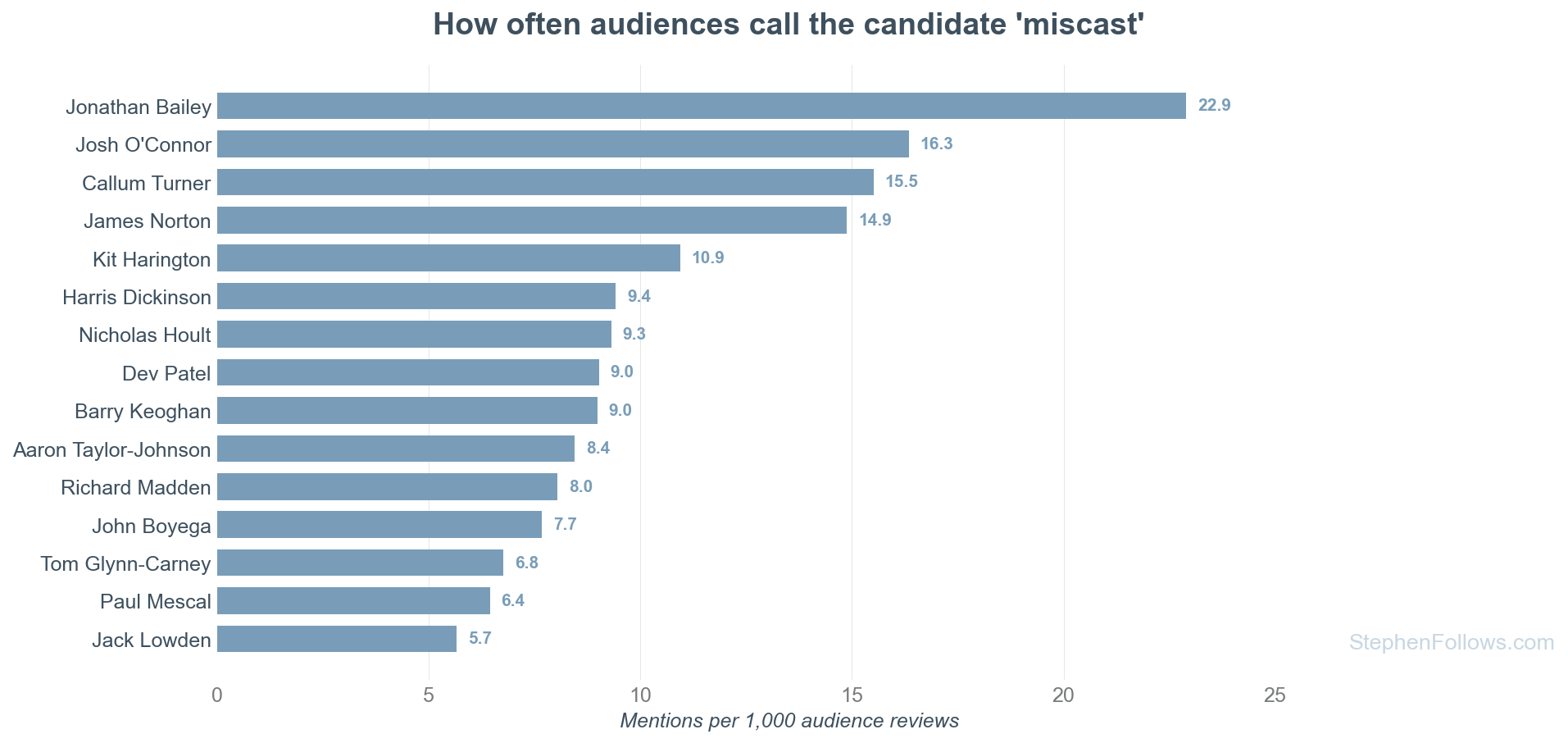
This could just be a case of not being cast correctly in the past, or it could be a signal that audiences are unsure about them.
An actor flagged as miscast might be miscast for a specific film because the casting director picked the wrong vehicle. Or because the director did not get a performance out of them. Or because they have not yet found their niche.
Even with all those caveats, the fact that Callum Turner, the current bookies’ favourite, sits in the worst third of his peer group on miscast mentions might be a concern.
3. Lots of charisma
The third proxy is the strongest of the three because it is the one most directly about the actor. Using the same audience review corpus, I tracked counts of mentions of the actor alongside things like “charisma”, “magnetic”, “presence”, “star quality”, “commanding”, and similar euphemisms.
Jonathan Bailey and Aaron Talyor-Johnson came up top (with the latter having a long history of being linked to the Bond gig).
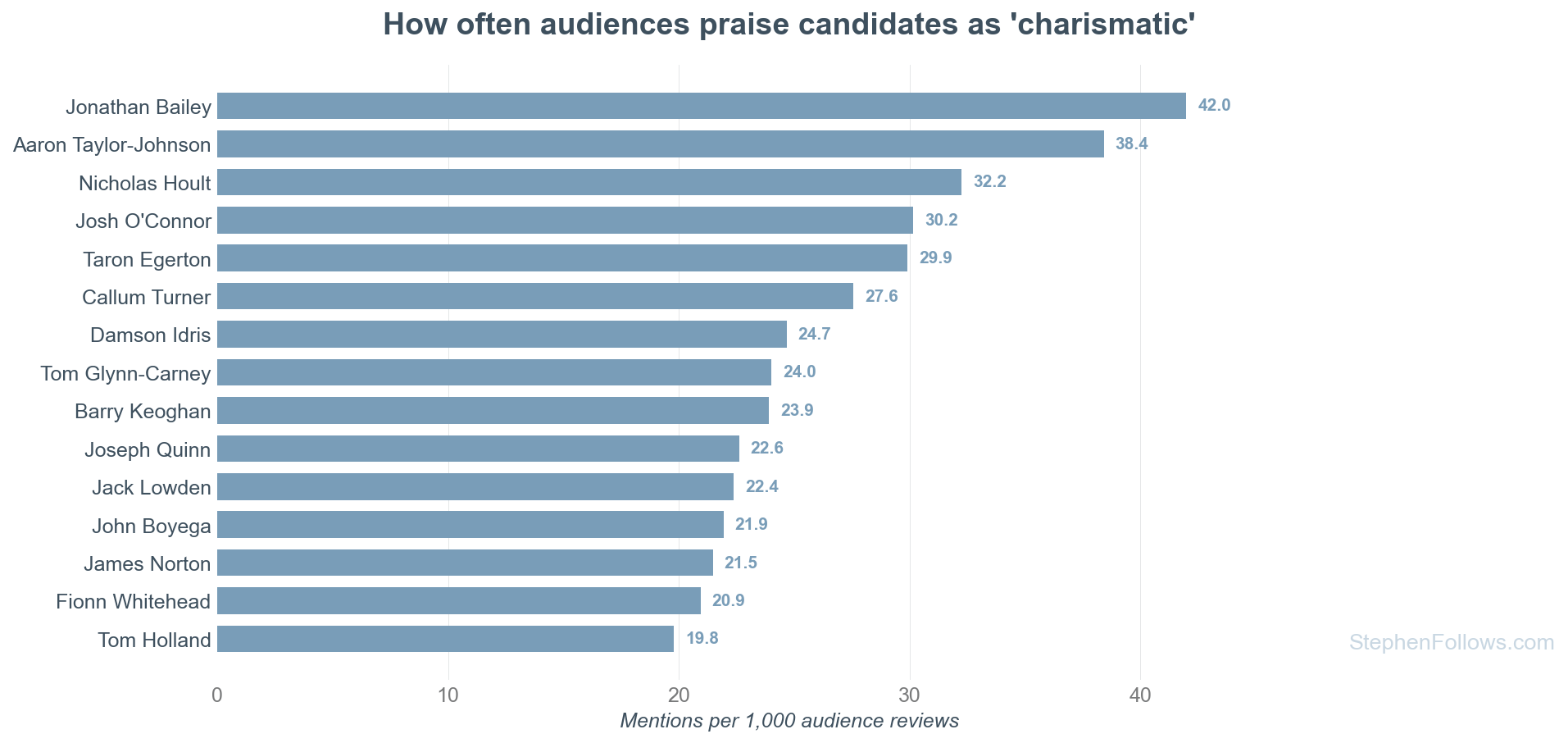
4. The right kind of famous
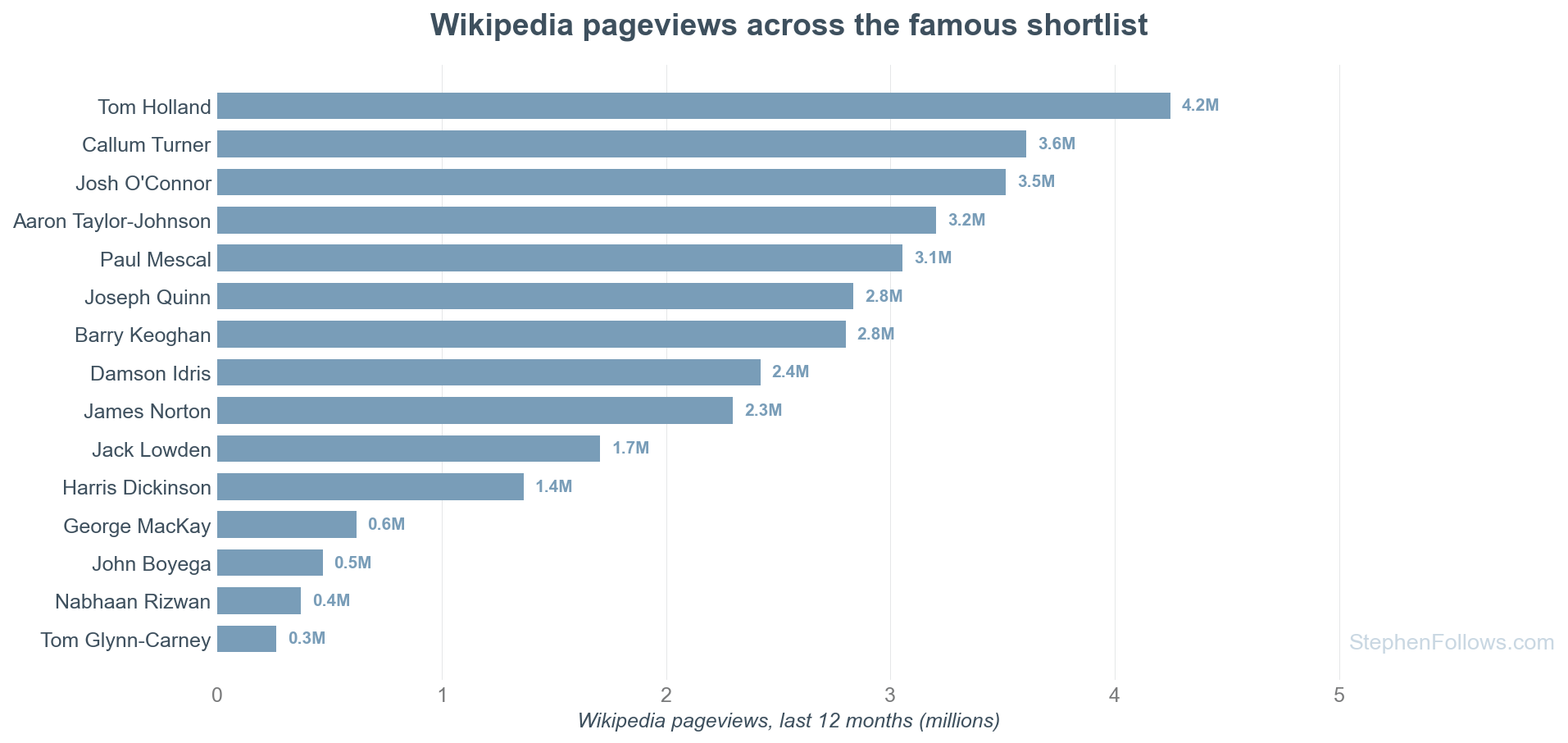
The perfect actor to play James Bond needs just the right amount of fame upon casting. Bond does not hire stars. Bond makes stars. McWilliams calls casting an unknown “a gift”.
For most lead roles, more fame is better as fame brings audiences, marketing, and secured financing. For Bond, fame above a threshold is a negative. They do need some basic level of fame so that audiences feel they have earned the role with a sense of gravitas (gone are the days of hiring a milkman to play Bond).
They also need to be affordable and controllable - two things that famous people are not. A famous star walks into the negotiation with leverage Amazon cannot compete with.
Bond casting is structurally closer to casting Harry Potter or Star Wars, in that you are not picking the actor someone is right now, you are picking the actor they are going to become.
For example, Tom Holland is a perfectly plausible Bond on every other criterion (except maybe height). He is also already in a Marvel contract that would constrain availability, already a household name, and already on his own profit participation deals. His audience is not Bond’s audience either. The studio loses leverage the moment they sit down with him.
The Daniel Craig Precedent (a.k.a. the Renée Zellweger Principle)
When Daniel Craig was announced on 14 October 2005, the internet had something close to a meltdown. He was blonde. He was 5’10”. His ears were “too prominent”. Two protest websites were launched within hours. Tabloids published photos of him in a life vest, struggling to get out of a speedboat. Den of Geek covered the backlash in detail.
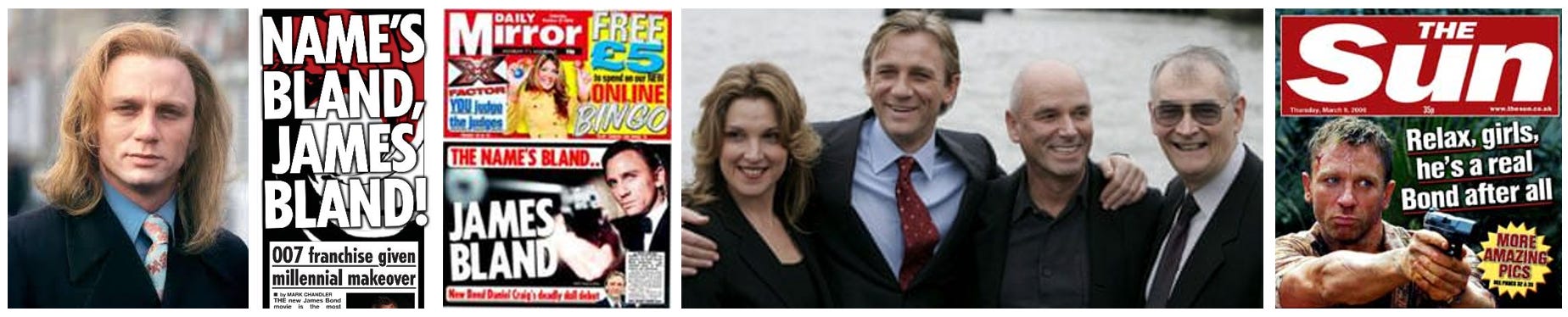
Then Casino Royale opened to 94% on Rotten Tomatoes. Craig’s five films grossed $3.97 billion. Skyfall became the first Bond film to cross a billion dollars.
The same thing happened five years earlier with a much less British example. When Renée Zellweger was cast as Bridget Jones in 2000, the British fanbase was furious. A Texan playing a national icon. Zellweger gained weight, mastered the accent, worked undercover in a London publishing house, and won the audience over. We do not now think of Bridget as miscast - we think of her as Bridget.
The rule has held for sixty years - Connery was not Fleming’s choice, Lazenby was not anyone’s choice, and Craig was too blond. You could argue that the audience does not know what it wants until you show it. And every time the producers have made a casting choice that contradicted public expectation, the franchise has thrived.
The $2.8 trillion elephant in the room
This is the part of the problem that the data cannot solve. The casting decision lies at the intersection of two shopping lists. The audience wants their Bond. Amazon wants their franchise. Those are not the same thing.
- Audiences want a Bond they recognise the moment he walks on screen, someone who feels like a continuation of the canon rather than a hard reset. He has to look the part, with the kind of bearing and physical presence the role demands, and light up a room the second he enters.
- Amazon wants someone cheap to sign, because the franchise is the star and the actor is replaceable. They want someone willing to commit to a TV universe of spin-offs, not just two films and out. They want an actor who’ll tolerate director-led work without demanding the final cut, and who’ll stay available and under contract for the next decade.
- The person who satisfies both columns is likely to be British, male, in his late twenties or early thirties, charismatic and properly trained, a working actor who isn’t yet a star, and someone who takes direction rather than fights it.
The true overlap among those people is no more than a handful. A source close to production told Deadline last year that:
99.9% of the names speculated online so far won’t make the cut.
Gun to the head….
I think it would be rather unsatisfying if I ended this article without proffering some names I think could be Bond.
Rather than making a subjective or artistic judgment, I’ll tell you what the numbers say.
At the time I was researching the video at the top of this article, the frontrunner was Callum Turner, with odds which imply he had already been cast. In my data, he scored pretty poorly. He has the third-highest miscast rate in the famous shortlist, and sits near the upper end of the casting age window.
If I had to pick someone who scores well but is priced badly by the bookies, it would be Tom Glynn-Carney. 31 years old, six foot one, a graduate of Guildhall, average film Metascore 65.2 and with a Wikipedia footprint of a quarter of a million pageviews (so known but a tenth of Tom Holland’s numbers). He has the shape of every Broccoli-era casting decision the producers have made.
Other top choices the data liked were Fionn Whitehead, Joseph Quinn, and Nabhaan Rizwan.

But any tweak to the criteria would massively change the order. Reweight charisma by even a few percentage points and Jonathan Bailey or Taylor-Johnson is on top. Decide that fame is a positive signal rather than a negative one, and Holland leads. Drop the British requirement, and Jacob Elordi is your Bond.
Bond casting is not really a maths problem. The producers are looking for the right unformed clay who walks into the room with the right ingredients, and who they can write a script for, build a film around, and brand for a decade. Oh, and who they can afford and control.
While data gives us fun candidates to consider, this kind of decision is only ever made by a small number of people over coffee in a private room.
1 Like
Well no time to die kinda made that impossible.